
What keeps modern manufacturing running behind the scenes? And, who makes sure it all works?
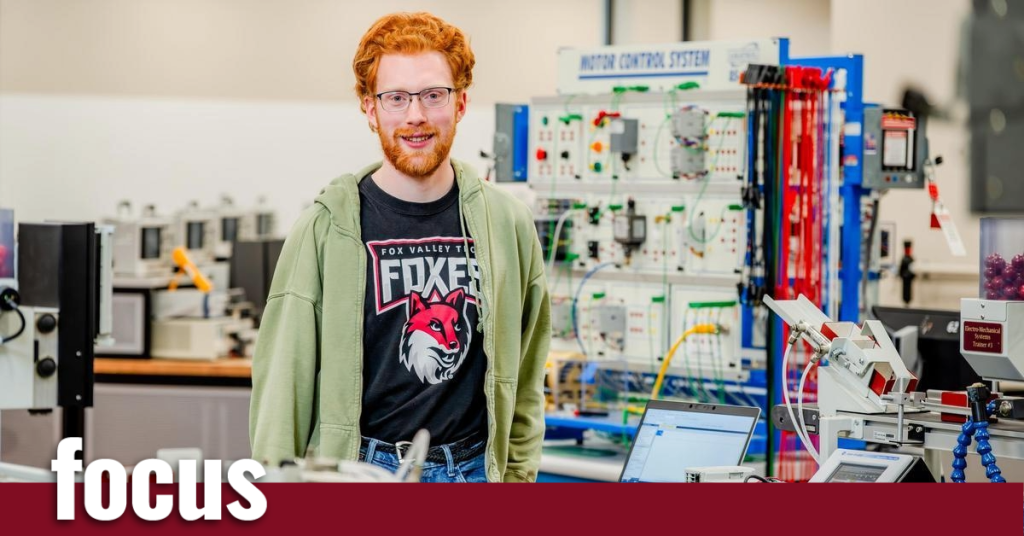
In this Focus on Careers interview on WHBY radio, Fox Valley Technical College instructor Aaron Daane gives a look inside the Electro-Mechanical Technology program, where students learn to bridge the gap between electrical systems and mechanical components.
From circuits and sensors to gears and drives, this program prepares students to maintain and improve the complex equipment that powers a lot of our local industries. The interview highlights the program, what kinds of positions graduates are ready for and a glimpse at the role students in this program have in the popular community project have, Go Baby Go.
Tap the video to listen to the interview or scroll down to read the transcript.
Hayley: All right. It’s our Focus on Careers. We will switch gears here for a moment, and we are going to highlight a program that is really appealing and really interesting. You might have heard about some of their efforts in news updates with the program called go, Baby Go. We’ll talk about that today. Aaron Daane is with us. Aaron is an instructor in the Electromechanical Engineering program. Good morning, Aaron. Thanks for being here today.
Aaron: Good morning, Hayley. Thanks for having me.
Hayley: All right. So before we dig into the program, tell us a little bit about how you became part of it and what brought you to Fox Valley Tech.
Aaron: So I’m an alumni of Fox Valley Tech. I did one of their manufacturing programs very similar to electromechanical program. So after graduating and working in the field for a while, an opportunity came up to teach at Fox Valley Tech. And I knew that that was my calling to take all the skills that I’ve learned over my years working and bring those back and make sure that other students were able to learn those skills and be able to help manufacturing in Wisconsin.
Hayley: I’ll be honest, Aaron, that when electromechanical engineering pops into my brain, I’m not quite sure what that is and what you do and what you’re teaching. So what exactly is electromechanical technology? What is that program at Fox Valley Tech?
Aaron: Yeah. So it’s kind of in the name. So we do have a lot of stuff that we teach about electricity. So, where DC and AC comes from, as well as all of the different electrical components that make up the manufacturing piece of equipment that our students use. So the sensors, the PLCs, so the programmable logic controllers that they’re going to use, we teach them about all the components that are inside there, just in case they would have to troubleshoot them and they understand how they’re working. And then the mechanical side of it, we do teach them a lot about chain drives, gear drives, belt drives. We get a lot into the mechanical stuff, bearings, just so that when they go out into the field, they should be able to look at any sort of manufacturing process that’s happening, kind of understand how it’s working. If something breaks, how they could take it apart and fix it. Things like that.
Hayley: Wow. Can you give us some examples perhaps of where your students are finding jobs? What are they typically stepping into?
Aaron: So most of our students are going to go into a career, probably in a maintenance field. So working in a manufacturing environment so that they would understand the process and when something breaks, they’d be able to step in and fix it, troubleshoot what’s happening. If they need to upgrade something, they know what’s out there and available to them. What they can do to upgrade that system; make it work better. So they’re going to work in manufacturing environments. They might also work for an OEM. So an original equipment manufacturer that’s making equipment that goes into a manufacturing environment. So they might go install that equipment, train the users how it works, and then make service calls if things break, need upgrades, things like that.
Hayley: A very important role.
Aaron: Very important. Yes.
Hayley: And in manufacturing and you know, manufacturing has evolved so much. And I would imagine that this program didn’t probably exist even what, 20 years ago ish, may be longer. You know, it’s always evolving, right? In different facets. Um, how does this job look different from what a graduate would have been prepared to do? Yeah. Ten, 15, 20 years ago.
Aaron: Yeah. So it has changed. Uh, things are becoming more computerized, a lot more robotics involved as well as the programming aspect. So the program really has shifted in the last ten years to give our students a lot more experience using the programming tools that they have available. Gettin used to the newer equipment. Um, that programming side of it’s just really another troubleshooting tool that they can use to figure out what’s going on when something doesn’t work quite right.
Hayley: All right. And how do you stay up to date with everything? Are you constantly monitoring? Are you constantly checking in with different manufacturers? How do you process that?
Aaron: Yeah. So twice a year we have an advisory committee. So, um, people from different areas in our manufacturing environment around us. They will come and they will tell us what the newest trends are, what they’re seeing. Maybe there’s a need, something that they’re seeing that our students are coming out of Fox Valley T/ech without. And then we’ll kind of assess that and see if that’s something that we need to add or change. If it involves us getting more training, then we’ll have to go and get that training so that we can provide that for our students.
Hayley: All right. And again, this is an associate degree program, correct?
Aaron: It is yes.
Hayley: And that means about timeline how when someone starts to finish. How long did that program take.
Aaron: So the program is designed to be a two-year program. Um, a lot of my students are working full time. Um, probably about 90% of them. Wow. So a two-year graduation is kind of rare in the electromechanical program. So if you’re a student coming straight out of high school, two years is no problem if you’re not working full time. A lot of our students are taking about 3 to 5 years to graduate just because the program is, it’s kind of designed to be flexible. So our students are usually working full time. They have a family and school is like number three on the list.
Hayley: So that’s a lot. Yeah.
Aaron: And so the way our program is kind of designed, it really helps them get those classes done. We run an open lab where we run all 42 of our core credits at the same time in that open lab. And that open lab is from 830 in the morning till 830 at night, Monday through Thursday, 830, 1230 on Fridays. And we also have an Oshkosh lab as well. And so we run all 42 of those classes there at the same time. Students can come in before work, after work, maybe after their family activities and work in their classes. And then one of the instructors is always there to help facilitate. Give them little mini lectures if they need and get them through the classes.
Hayley: All right. We’ll pause here, Aaron. But after the break, we’re going to talk about who might thrive in this program. And we mentioned Go Baby Go earlier. We’ll talk even deeper about this and how rewarding this program has been for the college, but for our community as well. All that coming up on our Focus on Careers with Fox Valley Tech.
Continuing our Focus on Careers with Fox Valley Technical College. Aaron Daane is with us, an instructor in the electromechanical engineering program. And I’m curious about a thriving student. What does that look like for the program? And you mentioned some students in the midst of family life and a full-time job, some, you know, fresh out of high school, but what qualities do you find help a student really, really thrive?
Aaron: So students in our area really thrive when they ask questions, when they want to know more, when they want to know deeper things like how things come apart. How they go back together. Why they’re made that way. So when they asked those other questions that really makes them a better student. Gets them a little bit more knowledge than just seeing stuff on the surface. Students who are self-starters, who can maybe make a schedule and stick to it, those students tend to thrive better in our program as well. Just because it’s a flexible program, we don’t have a set time for a lecture that they have to be there at a certain time. So it’s really up to them to make that schedule and make sure they get in and get that class done.
Hayley: What do you love about teaching in this program? What about this program? You know… fuels you every day?
Aaron: Yeah. So I like seeing the success of students. Seeing those aha moments when they finally understand something or they say, you know, I’m going to take this back to work and I can use this. Also, graduation. So when they walk across that stage, that’s a fulfilling feeling knowing that, yeah, they’ve completed it, they’re going to go out into the environment and improve in their job. Maybe they got a raise. Maybe they got that new position that they’ve been trying to get. And so that’s really a good feeling.
Hayley: I think another amazing program that has come from students in your program is Go Baby Go. Can we talk about this and the success it’s had all over northeast Wisconsin?
Aaron: Yeah. So Go Baby Go is a great partnership that we’re doing with Children’s Hospital in the Fox Valley. Um, so we did just recently in March, delivered our 99th and 100th car which we were not expecting to do that for a couple more years. So we’ve had a lot more interest in that.
Hayley: Yeah. And just to give our listeners a refresher how you adapt those little tykes. You kind of adapt these little miniature vehicles, correct?
Aaron: Yeah. So they’re like toys… kind of like a power wheel, something where we will adapt them to fit the needs of children with special needs. So we work closely with Children’s and the OTA program at Fox Valley Tech as well. So once a month kiddos who have applied to the program, they come in, they get fitted for a car, and then the Electronics Club will come in and I help them fit the cars out for the kids so that they can kind of have some of that mobility that they weren’t having before.
Hayley: Oh, it’s got to be rewarding to see those little ones in those vehicles.
Aaron: Yeah, it’s very rewarding seeing them get in those cars, driving around, uh, and the smiles on their faces, the laughs. Yeah. It’s great.
Hayley: I love it. I love that program. Every time it comes through. It’s one of those videos you can’t pass.
Aaron: Yeah, it’s a good one.
Hayley: It’s a good one. Anything else our listeners should know about Electro-mechanical technology? And just, uh, you know, the future of this program and its impact in the Fox cities.
Aaron: Yeah. So we are teaching, you know, great skills for people who like to troubleshoot and like to learn about different things, who want to kind of thrive in the manufacturing environment. The flexibility that we have is a great part of the program. We have five starts every year, and each one of those terms goes eight weeks long. And yeah, so there’s never a bad time to start in the program./
Hayley: All right. Well, let’s help fuel our listeners with information to inquire about or maybe apply. How can they do just that?
Aaron: Yeah. So if you’re interested in the Fox Valley tech and doing the electromechanical program, go to our website at http://www.ftc.edu. And in the search bar on the top, you can type in electro and it should take you to the electromechanical program.
Hayley: Perfect. Aaron, thank you for being here today.
Aaron: My pleasure.