Students in the Natural Resources Technician program remain in high demand, with career opportunities extending well beyond traditional employers.
Paul Groell, department chair of Natural Resources was recently interviewed on WHBY’s Focus on Careers. During the interview, Paul gave listeners an inside look at what kinds of careers opportunities open up with an associate degree in the program. Paul shares insight into the strong job market and the growing demand for graduates in natural resources careers.
Tap the video to listen to the interview or scroll down to read the transcript.
Micke: And welcome back to our final segment for Focus Fox Valley, this is Nancy Micke and Zach is with me here in the Miron Construction studio.
One of our favorite topics is Focus on Careers with Fox Valley Technical College. Always an interesting and fun segment that we offer here. And joining us today is Paul Groell. He is the department chair of the Natural Resources Program. Welcome, Paul. So thank you. Nice to have you join us.
Groell: Thanks for having me.
Micke: Yes, we are happy. I said, I said when we walked in, your job just sounds like a fascinating title and something that you would really enjoy. And you said, yes, it is, it is.
Groell: It is very enjoyable and unique. Um, and I tell my students all the time, uh, when I was in college, I never dreamed of being a teacher, but being in the field for many years. And then I started teaching as an adjunct faculty at Fox Valley Tech in 2002. So I just taught a class here and there. I did some tutoring and some curriculum development for the program, and then, uh, became a full-time instructor in 2010. So I have been in that role ever since. I have been the department chair since 2013.
Micke: Wow. So that is a great progression. Yes. And like you said, never thought about being a teacher, but who knows.
Micke: Who knows where life takes you, right? Yes. So let’s start right from the beginning. Tell us about the Natural Resources Technician program. And, you know, people are always interested. Is this something that you would get an associate degree for?
Groell: Yes. The natural resources technician program is an applied associate of science degree. So it’s technically a two-year, four semester degree. Some people take five semesters, but it is an associate degree. Oftentimes our students do go on to earn a bachelor’s degree at another school. So we have some articulation agreements with UW schools, specifically Stevens Point and UW Stevens point. And if they want to transfer their credits onto a four-year school, they can get pretty good transferability of that. So up to 58 credits of our program credits would transfer to Stevens Point if they do want to go on for a bachelor’s degree.
We do also have a lot of students that go directly into the workforce, and there’s quite a few jobs that they can qualify for as a technician with that associate degree. So some people choose to work right away and maybe later in life, go back and get some additional training or some college credits. But, um, there are a lot of options available to them.
Micke: And, you know, you talk about natural resources, so you get a focus in your mind of who you think might be that person. But you tell us what kind of students are typically drawn to this program. You know, who’s a, who is a good fit to be interested in?
Groell: Yes. I think, um, the, the standard answer I get when I ask my students, you know, what brought you to this program? It is — I like to work outside. I like to hunt; I like to fish. I like to be in the environment. It goes beyond that, though. I mean, inquisitive mind, you know, people like to be hands on problem solving and do that in a variety of environments. One of the best advantages to this career is that I could tell people from experience and from what my training is, that you get to work on something different all the time. It is not just the mundane. It is not typical day to day. You might be in the stream one day and in a forest one day and, you know, in the office sometimes. So I tell them, we go out when it snows and we go out when it rains and when it is cold. But we are also out there when it is beautiful weather, you know, in the fall, you know, and so we, we get to benefit from that.
But people that like science, people that are interested in protecting the environment, improving conditions, you know, the people that are inquisitive, those are usually the ones that we, we see attracted to our program and high school students that tour ask me a lot, what can I do to prepare for coming into a career like this? And I tell them, take a lot of science classes, you know, in your high school credits, take whatever you can. That will prepare you… some math as well. But the sciences really give you a jump start into this type of a career.
Micke: That is interesting. You know, you said they asked you what we should be doing? What should we be taking? Um, but they also probably want to know what kind of training or experience they get when they are going to join your program? What is the day going to be like when I am taking this class?
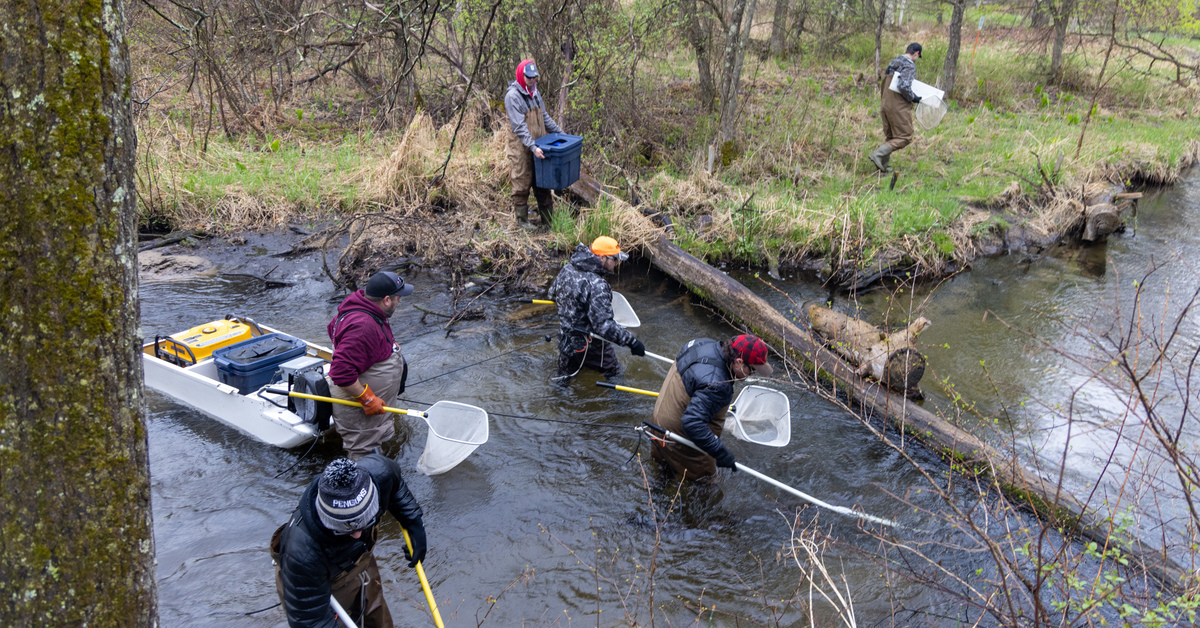
Groell: Yes, and that is one thing about… the difference that sets us apart from many four-year schools is we are a technical college. And one of the main emphases is on hands on learning. And so we do a lot of practical outdoor lab type stuff. We work with a lot of equipment. We do cooperative volunteering with the DNR and Fish and Wildlife Service and other agencies. Land and water conservation department. So we are on actual job sites. We are in the streams.
My students in my fisheries class right now are out with the DNR, helping them with their spring fisheries assessment, checking fyke nets and electrofishing. And so they are doing a lot of the hands-on stuff. They learn how to do maintenance, basic maintenance on some equipment, and how to operate certain equipment. And so the hands-on portion, the practical application is what really sets our students apart from someone who had more of a theoretical background from a four-year university where there were not as much of the practical applications. So they can be competitive in the job market.
Micke: So, you know, around here we are close to sturgeon fishing, and we had a good season this year. Would your students do something with sturgeon fishing?
Groell: Correct. So during the February sturgeon spearing season on the Winnebago pool lakes and Lake Winnebago, my students would help the DNR at the sturgeon registration station. So every fish that was speared, by law, must come in and get registered in person. And my students are embedded with those crews, with the DNR staff and they help with the weighing and the measuring and the staging for reproduction and all that stuff. So it is a cool way to start off the semester. When I start my fisheries class in January, day one, we start talking about sturgeon fish because before Valentine’s Day, that season opens. And so there we have a lot of learning to do before they get up to that, to that level. But they do get to right away, get into the field and start out with that. And then now coming up here in April, we will have sturgeon spawning. So the fish will now be, you know, extending upstream, uh, for their spring spawn. And we can participate in that kind of work as well when they are doing the assessment on the river.
Micke: Yes, that’s, that is a great example of, you know, a concrete example of the type of things that they would be doing.
Groell: And it is so unique for this area. Most places do not have this kind of sturgeon population. So yes, when they can take advantage of that, it is helpful.
Micke: It is something that the longer I live here, the more I appreciate, you know, the uniqueness that we have and look forward to it. You know, we talk about curriculum and you mentioned that you have been in your position for quite a while. So I imagine you have seen some changes over the years with the curriculum that you have now versus what it was maybe a few years ago. What kind of changes are you seeing?
Groell: We do see fluctuation in number of credits in the program. It used to be up over 70 credits, and then there was a concerted effort to try to bring credits down in some of these programs to make them more attainable and like a little bit less time in the program.
But for curriculum as well, there’s just shifts in technology and the types of equipment that we use and methodologies that we use. The basics are the same as they have been for decades. You know, wildlife management, fisheries management, surveying, soil and water conservation, forestry, those basic learning, you know, those attributes do not change too much.
But how we approach things, the technology that we use, the equipment is becoming lighter, faster, more mobile; surveying equipment is very different with GPS and all the different things that we use wireless now, that has changed quite a bit. Uh, and then we try to infuse that into the curriculum as well. So using drone technology, UAVs, exposing them to that, exposing them to different software and geographic information system or GIS software programs, so they can use those as soon as they graduate, they hit the ground. They are, you know, able to operate in their job because they have had some of that experience.
Micke: Yes, really hands on. That is cool. This is Focus on Careers with Fox Valley Technical College. We are talking with Paul Groell, who is the department chair of the Natural Resources program. It is time for us to take our final break of the day. But stay with us. We will have more with Paul and hear more about this wonderful associate degree program after these messages. So stay with us here on Focus Fox Valley.
And we are back with our final segment of Focus Fox Valley. We are talking with Paul Groell, who is the department chair for the Natural Resources Program at Fox Valley Technical College. And we have been talking about the program itself. And, you know, one of the things people are always interested in when you talk about what kind of career you should go into is what the job market is like. So what is the job market like for natural resource graduates, what kind of jobs are your graduates?
Groell: Getting to the job market today is very good, way better than when I got out of college. I tell my students that all the time. There is an abundance of seasonal, part-time and temporary jobs, but there are also quite a few permanent full-time positions available due to a lot of retirement and turnover within these different organizations. And let me just say up front too, it is not just public sector. There are private sector jobs available as well. There are a lot of consulting businesses that focus on natural resources management. And there are other things with private contractors, things like that.
But as far as the overall job outlook, it is very, very good. And so there are way more positions available than I can crank out students, which is a good outlook to have. And they are going to be employed across the nation, not just in the Midwest, in all different areas within natural resources management. So when you think about Wisconsin DNR, you think about Fish and Wildlife Service, U.S. Forest Service Soil conservation, which is now the NRCs. And then land and water conservation departments across the state. Each county has one of those. So those are some areas that traditionally our students are getting employment in.
Some things that I have seen increase in recent years are in the wastewater treatment field. We do have some wastewater courses in our program. And so our students come out prepared to take an exam with the state, get certified as a wastewater operator, and with a two-year degree, you can get into some pretty good paying jobs with very good benefits in that wastewater and water supply field.
Land and water conservation departments hire a lot of our graduates as well because it’s a good balance of hands-on resource management, land management, and then a little bit of the overlap with agriculture because we were working with a lot of agricultural producers and helping them manage their land and run off. So there are a lot of different positions available, but it is a very good time to be entering the field.
Micke: It is always good when you say there are more jobs out there than the number of kids I can crank out with a degree. So that is a big deal. We do not have a lot of time left but I will ask you, what is the most rewarding part of your job?
Groell: I think seeing that where you have someone who comes in with very little experience or knowledge about what natural resources management is, and then they pick up one aspect of it, one discipline within resource management and become super passionate, start volunteering, get all kinds of job offers. And I have got several people graduating in May that have already got like 3 or 4 different job offers that they must decide. So now they are stressing about which job I should take, which one should I turn down? And that is a nice problem to have.
Micke: What a great problem to have. Thank you for joining us today.
Did you know?
In January of 2026, a 160-acre property near Hortonville was donated by its owner to the Fox Valley Technical College Foundation. The property will serve as an outdoor classroom for students in the Natural Resources program.
Learn more in this report from WBAY-TV: FVTC receives 160-acre land donation