
Want to learn a foreign language? Check out our class information and schedule at: www.fvtc.edu/global
Capital: Damascus
Currency: Syrian Pound (SYP)
Geographic location: Middle East, bordering the Mediterranean Sea, between Lebanon and Turkey.
Climate & Terrain: Hot, dry, sunny summers (June to August) and mild, rainy winters (December to February) along the coast; cold weather with snow or sleet periodically in Damascus. Primarily semiarid and mostly desert plateau; narrow coastal plain; mountains in the west.
Population: 22,457,336 (July 2013 est.)
Religions: Sunni Muslim (Islam – official) 74%, other Muslim (includes Alawite, Druze) 16%, Christian (various denominations) 10%, Jewish (tiny communities in Damascus, Al Qamishli, and Aleppo)
Ethnic Groups: Arab 90.3%, Kurds, Armenians, and other 9.7%
Government System:Republic under an authoritarian regime
Languages: Arabic (official), Kurdish, Armenian, Aramaic, Circassian (widely understood), French, English (somewhat understood)
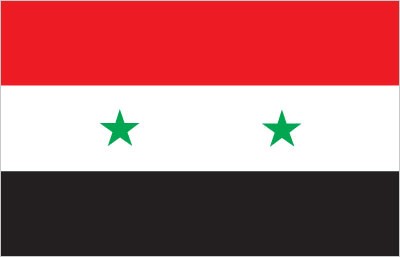 |
The flag of Syria Three equal horizontal bands of red (top), white, and black; two small, green, five-pointed stars in a horizontal line centered in the white band; the band colors derive from the Arab Liberation flag and represent oppression (black), overcome through bloody struggle (red), to be replaced by a bright future (white).
The flag is identical to the former flag of the United Arab Republic (1958-1961) where the two stars represented the constituent states of Syria and Egypt. The current flag design dates to 1980.
Little-Known Facts:
- Syria still has remnants of the major roads that were used over 4000 years ago, for connecting Aleppo (Syria) and Ninevah (Iraq)
- Located at an oasis fed by the Barada River, Damascus has been inhabited for over 4000 years, making it the oldest continuously inhabited settlement in the world
- Damascus was once a major center for weaving and trading in textiles. Damask — using an ancient technique for weaving patterns into cloth — derives its name from the city
- Ugarit, Syria, is the place where the oldest alphabet of the world is believed to have originated
- Argentinian connection: About 1.3 million Argentinians are of Syrian or Lebanese origin, many of them having settled there during the 19th century
- Steve Jobs, one of this century’s most admired people was Syrian-American and didn’t know it for most of his life. Jobs’ biological parents, University of Wisconsin student Joanne Schieble and Syrian-born teaching assistant Abdulfattah “John” Jandali, gave him up for adoption to Paul and Clara Jobs.
- Other Americans of Syrian descent are the singer-dancer Paula Abdul (who calls herself a “Syrian-Brazilian-Canadian-American”), comedian Jerry Seinfeld (on his mother’s side) and Indiana Gov. Mitch Daniels (on his father’s side)
- The civil war was set in motion after President Bashar al-Assad violently suppressed pro-democracy demonstrations in 2011
- In February 2012, several world leaders condemned the massacre by government forces of 300 people in the city of Homs. The United Nations estimates that about 1,000 people have been killed in fighting so far, with millions displaced by the conflict
Mini Language Lesson:
Modern Standard Arabic is the language of education, but is not native to anyone.
At home, most Syrians speak dialects of Levantine Arabic, specifically South Syrian Arabic, spoken in the cities of Damascus, Homs and Hama, and North Syrian Arabic, spoken in the region of Aleppo. Allied Dialects are spoken in the coastal mountains.
Commonly used words:
| Aff-one | Excuse me, pardon me, I beg your pardon, Allow me, one minute please, do not mention it, its my pleasure, Please, Thank you |
| Ba-sss | Enough, that’s all, stop doing, prevent, interrupt, cease, bring or come to a halt, finish, break off, call it a day, discontinuation |
| Shou-Kran | Thank you, very kind of you, I am grateful |
| A A | Yes, Yes (you make a gesture by nodding the head down) |
| La la | No, no (nod the head up) |
| La Shou-kran | No Thank you |
Greetings & Questions
| Hello | Marhaba |
| Good morning | S-bahh Al-khair |
| Good evening | Masa Al-khair |
| Please | Men-fadllaak (m) if you are speaking to a male |
| Please | Men-fadllake (f) if you are speaking to a female |
| How much? | Gha-daish? |
Want to learn a foreign language? Check out our class information and schedule at: www.fvtc.edu/global