Cybersecurity Specialist program creates ‘turnkey’ graduates
It involves mystery. Fascination. And a healthy dose of suspicion.
Those are just a few of the qualities that have attracted students Kim Hinson and Bhuwan Tiwari to Cybersecurity at Fox Valley Technical College.
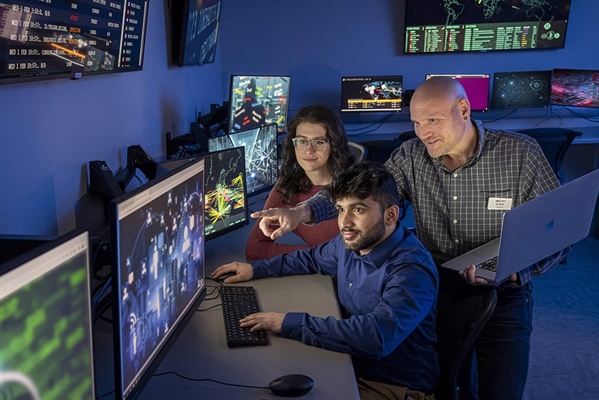
IN PHOTO (l-r): Kim Hinson, Bhuwan Twari and instructor Joe Wetzel in the FVTC Cybersecurity Command Center, or DMZ.
Kim will graduate in May with a Cybersecurity Specialist associate degree. Her previous career was in cosmetology but while doing some soul-searching during the COVID-19 pandemic she decided to start a new career.
“Honestly, what drew me to the program was the concept of hacking,” Kim offers. “By that, I mean the ethical way of being a hacker and doing it for the good of other people.”
For Bhuwan, he wants to incorporate Cybersecurity courses into his learning while he pursues Software Developer and Web Development & Design Specialist associate degrees.
“I am fascinated with cybersecurity because as a developer, I’m writing code that could affect millions of lives and I have to be aware of vulnerabilities,” Bhuwan explains. “I need to think about how someone could breach the program as I’m writing it.”
New Name, New Appeal
FVTC has long offered Information Technology courses that touch upon security. But in recent years the Information Systems Security Specialist program was renamed Cybersecurity Specialist program to better reflect what students would learn.
“Before, the curriculum focused on guarding data, policies, and safeguards to keep information secure,” explains Joe Wetzel, department chair of Information Technology. “Cybersecurity Specialist gives us the flexibility to navigate between multiple areas; it deals with software, networking, policies and human factors. It’s interwoven into everything.”
Ethical Hacking as Education
The Cybersecurity Specialist is a 61-credit associate degree that includes courses like Network Essentials, Operating Systems Security, Computer Crime Investigation, and yes, Ethical Hacking. The class exposes students to techniques hackers use to discover vulnerabilities in systems. By learning how a hacker thinks, students learn how to react to protect computer networks.
“It’s a shift in how our students think,” Joe explains. “In class, we may start with a vulnerable system and the students must exploit it, then they realize, ‘Wow, this is bad. How can I make sure this does not happen to me?’ Then they go through the process of securing the system. They learn to mitigate it and prevent the security breach in the future.”
Two-Year Program a Cyber Success Story
As a two-year program, Joe says the goal of the program is to give students the tools they need, train them on those tools and processes, and get them into the industry as quickly as possible. Joe sees his students being hired by local employers and watches as they get promoted or move on to even better positions. They are graduates with options.
“Some students prefer working on creating security policies,” Joe explains. “Some work on securing networks, while others are developing commercial security software.
“I believe our students like Kim and Bhuwan are as prepared as a four-year graduate to start their career. Our students graduate knowing many tools and processes employers use before they enter the workplace and can get to work right away. Our students are turnkey.”
What is the DMZ?
Tucked away in a corner of the college, you can find students in the college’s Cyber Security Command Center. Also referred to as the DMZ, it is a safe space for students to compete in ethical hacking competitions against each other or other colleges. Students work on challenges like decoding strings, cracking passwords and even more aggressive challenges like port scanning and brute force activities. Students get points when they complete a hacking challenge. There is even a leaderboard to track the competitors.
The DMZ is completely segregated from the college network and creates a safe internet space where students can do these ethical hacking activities within systems and networks that have established boundaries.
Career opportunities as a Cybersecurity Specialist:
- Information Security Technologist or Analyst
- Incident Response Specialist
- Cybersecurity Analyst
- Cybersecurity Professional
- Security Technology Analyst