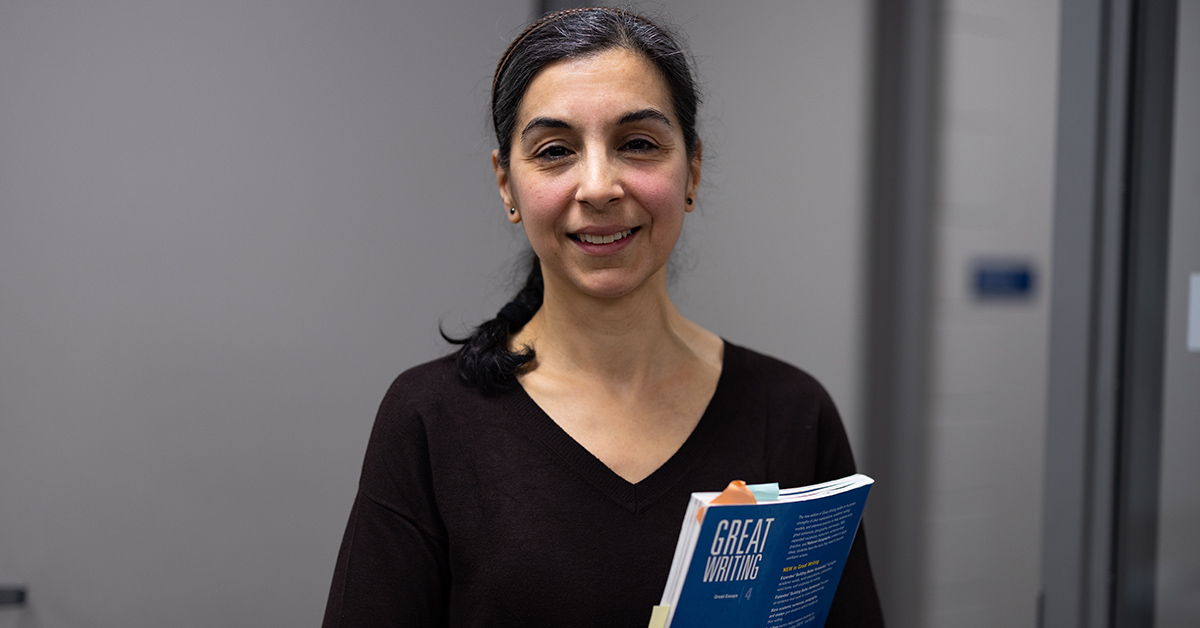
Maria Carone, Ph.D., understands the power of language. Born in Germany, she not only speaks four languages (English, Spanish, German and Italian), she has also spent her career teaching others how to communicate with each other and appreciate our differences.
“I want students to know how powerful language can be in shaping their thoughts, conveying their messages, defending their interests,” Maria says. “If they know not only what to say, but how to say it, it becomes a very powerful tool. And that’s a skill that they will use far beyond college.”
Of all the places in the world she has taught, her favorite place is right here at Fox Valley Technical College. Learn more about Maria in our FVTC Faculty Spotlight.
What classes do you teach?
I teach a variety of classes in the World Languages and Culture program. I teach foreign languages, I teach English to international students and community members, but I also teach for other programs. I teach English for native speakers, for students who want to learn how to become better writers and better speakers. I really teach communication, how people can communicate better with each other, but also with students from other cultures, with people from other countries.
What did you do before you worked at FVTC?
Before I worked here, I taught at larger public universities in Germany and Italy. When I came to the United States, I taught at UW-Madison and some private liberal arts colleges. They really helped me realize how much I enjoy teaching. Here at FVTC, I like the student population. The students that enroll here go to college not because they’re supposed to, not because they’re pushed by their family and their parents, but because they know what they want to be, and they know what they want to study. They’re passionate about what they’re doing. And that really motivates me as a teacher to support them in their goals.
Why did you go into teaching?
I always enjoyed teaching, since I was very little. I love teaching because it is hard to become a monotonous routine; every day is a new experience. Every class is different. Students change drastically over time. I’ve been teaching for a quarter century now and the students always change. I love to see their faces light up with understanding and I also love to learn from them. I love to listen to their own experiences. I grew up always enjoying going to school, and now I get the chance to be a lifelong learner every day.
What do you enjoy most about the classes you teach?
I like to empower students; I like to give them a voice. I teach language and communication, and I want them to know how powerful language can be in shaping their thoughts, conveying their messages, defending their interests. If they know not only what to say, but how to say it, it becomes a very powerful tool. And that’s a skill that they will use far beyond college.
Learning about cultures different from our own makes us more knowledgeable, more understanding and more compassionate human beings.
—Maria Carone, Ph.D.
What’s one piece of advice you have for students?
I would tell them to study a foreign language and travel abroad. Travel the world while you can. Learning a foreign language is a humbling experience. With it comes not only the knowledge of words and grammatical structures that are different from our own, but also the experience of new and different cultures. You start seeing your life just as one of many on this planet. And you learn to appreciate the value of differences. They make us who we are. They make us unique. Learning about cultures different from our own makes us more knowledgeable, more understanding and more compassionate human beings.
What skill are you currently working on?
I’m investigating to what degree AI tools can accurately translate from one source language to a target language. And although they have come quite far, they are still incapable of reproducing the complexities of cognitive human processes involved when we speak to each other and convey an often indirect meaning.
What’s one thing about you that might surprise your students?
I come from Europe, and so what I really enjoy doing with my students is showing them how other countries have other values. They’re always surprised and look at me in disbelief when they realize, for instance, how punctuality is seen differently elsewhere. Being punctual in the U.S. doesn’t mean to come to class when class starts, but five minutes earlier. Being punctual elsewhere can mean arriving 15 minutes after the official start of the class. That doesn’t mean that one is better than the other. It just shows how we, as individuals from different cultures, construct time and space differently. It’s invaluable to know because it helps us to understand each other, avoid conflict and foster coexistence.
What do you like to do outside of the classroom?
When I’m not teaching, you can find me outdoors with my family. You can find me in my garden wearing a sun hat with my hands in the ground. Or you can find me boarding a plane and traveling abroad.
What was your first job?
My first job many years ago, on a distant continent, in a different life, I was a translator and interpreter. Actually, I was a simultaneous interpreter, which is a fast-paced job. You don’t get to listen first and then summarize the gist of what is being said. You have to communicate and translate at the same pace as one person talking to the other. It was fun and I had to work with different people. It’s pretty much what I do here. It’s fast-paced and I have students from all backgrounds. It’s your brain on Zumba.
What was your best job?
My best job is here at FVTC because I love the students here. In contrast to all other schools I’ve taught at, FVTC students enroll not because they are expected to go to grad school, but because they’re genuinely driven by a desire to learn, to become experts in a field they are passionate about and for which they are willing to invest their time and efforts.
Learn more about the Languages & Cultures programs at FVTC >>