
Just as a wrench or a hammer is a tool in a toolbox, so too is machine learning.
And though it is new and relatively uncharted territory, leaders and faculty members at Fox Valley Technical College are dedicated to not only finding innovative ways to teach our students, but also how to model ethical behavior for our students as they prepare to enter the brave new world of artificial intelligence (AI).
“Generative AI has almost limitless capabilities and building an AI skill set will become important in most roles in the workforce,” explains FVTC AI Strategist Jay Stulo. “AI can help students by serving as a 24/7 tutor on virtually any subject. We envision AI becoming embedded in many of our programs in the near future.”
Here is a sampling of the areas experimenting with AI across the college.
Diesel
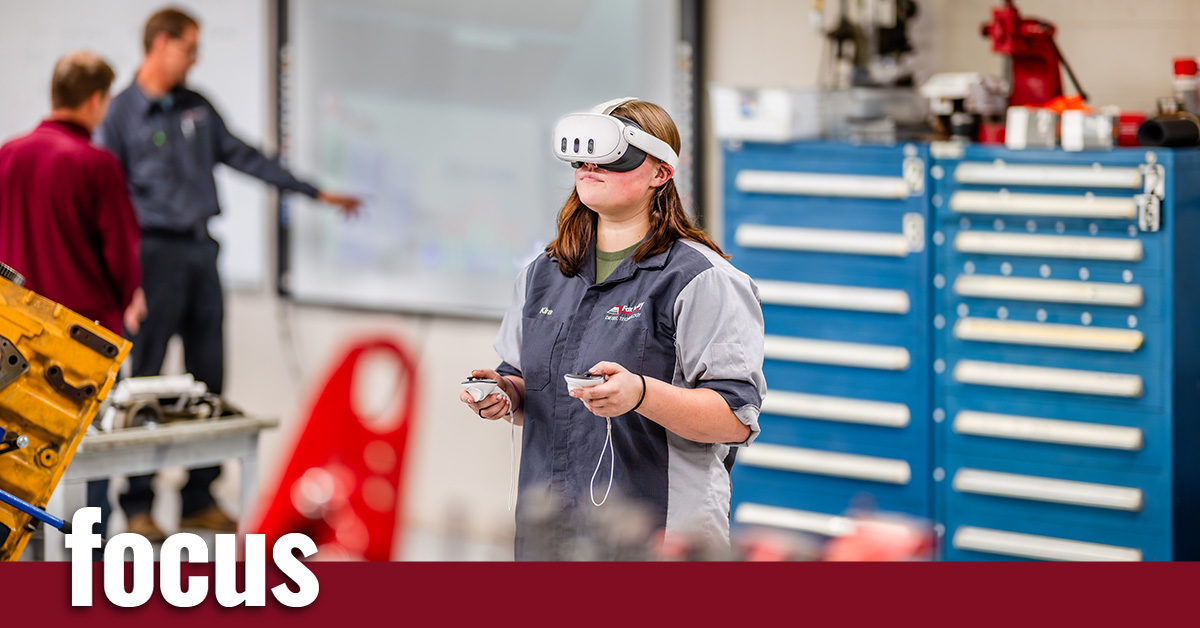
In the Diesel Equipment Technology program, work is underway to create a first-of-its-kind chatbot to help students better understand the inner workings of a diesel engine. Instructor Jay Duca is working with Virtual Reality Developer Josh Janikowski to build the experience.
“The virtual instructor will guide students through the diesel engine’s combustion cycle,” Josh says. “It explains complex concepts in detail and interacts through voice commands.”

Jay adds, “Our goal is to enhance the student experience. This will be incorporated into our regular lab activities and will help students understand the complete combustion cycle of a typical heavy-duty diesel engine.”
Diesel student Kira Paitel has been helping with the project as well, after seeing Jay map out content on a whiteboard. “I got involved out of simple curiosity,” she says. “I ended up talking with Jay for about an hour after class, just discussing the chart with the pistons labeled and each position they would be in with relation to each other. Jay let me try out the goggles that show the pistons for a Cummins ISX15 engine. I was amazed with the program and Jay asked me to help with the project and give feedback on the programming.”
Experimentation with innovative technology is not new to the FVTC Diesel program. In 2017, the eLearning & Technology Solutions team worked with Jay to pilot a HoloLens diesel engine, allowing students to use augmented reality to literally see through the engine’s layers to diagnose issues. The diesel engine chatbot is the next generation of this interactive learning experience.
Healthcare
In the Health division, Nursing faculty are using an AI tool called Casegen RN which creates case studies, scenarios and exam questions as well as a chat tool called Poe AI. “I got the idea to create a pharmacology chatbot on Poe from a nursing conference,” says instructor Jennifer Zernzach. “It’s like ChatGPT or any other service, however it is uploaded with information from my pharmacology lecture PowerPoints and the online textbook. When students ask questions, the information provided will be exactly what we are learning.”
FVTC’s learning management software Blackboard Ultra also includes an AI tool, which Allied Health instructor Heidi Menting has started using. “Ultra’s AI tool helps me create test questions from chapter material, creating assignments for students to delve deeper into content to chat with a bot,” she says. “I still need to review and make changes, but it is a great starting point.”
I found that students were using AI anyways, so I decided to make them use it to teach them how to do so responsibly.
—Rebecca Smith, Medical Laboratory Technician Department Chair
Rebecca Smith is the department chair for the Medical Laboratory Technician program. “I found that students were using AI anyways, so I decided to make them use it to teach them how to do so responsibly,” she explains. Rebecca incorporates AI tools to help students research topics and create presentations. “I have students show me how they fact-check with reliable resources and then find an article within the last three years from a reliable source,” she adds.
Information Technology
Instructors in the IT division are not only experimenting with AI technology to teach but are also actively researching tools and projects to provide students with relevant AI training.
In her Intermediate Data Analytics class, Carolyn Challoner incorporates part of the AI unit from Microsoft Learn. “It covers Azure AI Language’s natural language processing (NLP) features, which include sentiment analysis, key phrase extraction, named entity recognition, and language detection,” she explains. Sentiment analysis and topic modeling are also covered in the Programming in R class.
Carolyn also uses Microsoft Copilot in her Systems Analysis class, allowing students to simulate conversations with stakeholders when they are gathering requirements for systems.
Brian Foote encourages students to use AI for their final projects in his Advanced Software Development class. In previous semesters, group projects integrated an AI-based program that a user can play chess against.
Students are also learning about predictive analytics, machine learning and the ethics of AI, and faculty are using Poe AI to help students enhance their learning experience. Poe can take various input elements like PowerPoint slides, PDF documents and video recording transcripts to generate chatbot elements that students can access to answer questions about what was discussed in a lecture.
Professional Communications
AI is becoming a vital tool in professional writing. It can eliminate monotonous tasks and expand creative potential. “Our students learn how to integrate AI into their writing processes, preparing them for real-world tasks while emphasizing the importance of human creativity and originality,” explains Sarah Rivet, department chair for the Professional Communications program.
Eight courses in the Professional Communications program incorporate some form of AI. For example, in the Information Design class, students explore AI’s role in instructional design, craft precise prompts for AI content creation, and address the ethical, moral and legal implications of AI in communications. Students enrolled in the Intercultural Communications class use AI to generate questions for cross-cultural interviews and create their own reports based on the interview data.
Other courses incorporating AI include Grant Writing, Research Methods and Writing Content for the Web classes.
General Studies
In the General Studies division, written communications instructors encourage students to use AI to help them ensure correct grammar usage and improve the quality of their assignments.
AI should augment a person’s abilities, but the person is the valuable part of the equation.
—Jay Stulo, FVTC AI Strategist
Student Success
Beyond the classroom, AI is being used to help with student success. A student app is currently in development and features an embedded AI chatbot trained to answer student questions about the college. The chatbot will provide students with quick access to key resources and information to help them thrive.
AI literacy training for all staff is also in the works. “We’re being proactive,” says Jay Stulo. “Our goal is to support and encourage the ethical use of AI to support instruction and college operations and firmly believe in a human-centric approach. AI should augment a person’s abilities, but the person is the valuable part of the equation.”