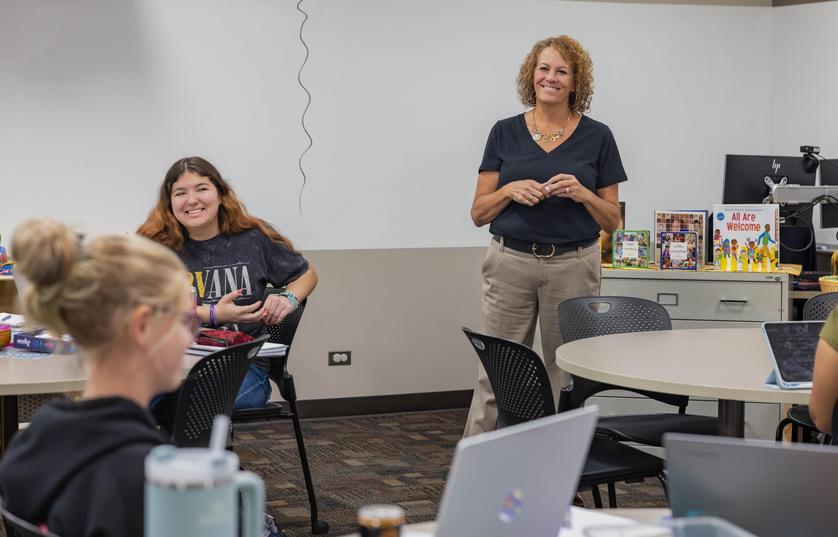
For Kathy Meetz, teaching future early childhood professionals is more than a career. It’s a chance to build meaningful connections and help students discover their own potential.
An alumna of FVTC’s Early Childhood Education program, Kathy has come full circle, returning to the college that helped launch her career to guide students as they take their first steps into the field. She is currently the Department Chair for the program.
In this Q&A, she reflects on her path from student to instructor, the mentors who shaped her leadership style and the relationships that keep her passionate about teaching.
What classes do you teach?
I’ve taught many of the Early Childhood classes. Currently though, I coordinate and teach Field Experience 1, which is for students are coming into the field for the first time. We put them out in the field in different placements. That could be group childcare, it could be family childcare, or it could actually be their place of employment as well. I also teach Foundations of Early Childhood and Guiding Child Behavior.
What did you do before you worked at FVTC?
I came directly from the Appleton Area School District (AASD), and prior to that I worked at the Appleton YMCA. Interestingly, I graduated from Fox Valley Tech in the program that I teach in. I’m a graduate of the Early Childhood Education program. After I graduated, I went to the Appleton YMCA and was employed there in an entry-level position and then just kept him moving into different positions along the way; doors kept on opening up. One of the things I did was start before- and after-school programs throughout the community. In that position, I was connecting a lot with the AASD because our programs were housed within their schools. Eventually the AASD received a federally funded grant to support before- and after-school programs, and they asked me if I would be interested in managing them, which I did. When I was doing that, I also was an adjunct instructor here at FVTC teaching School-Age Child Development. When the last of my instructors retired, I was like, well, maybe that’s something I’d be interested in doing more than just adjunct, so I interviewed and was offered the position.
Why did you decide to go into teaching?
At first didn’t choose Early Childhood; I didn’t choose teaching. I think I relate with students really well because my story is a lot like theirs. I went to a four-year university because at that time, there was a lot of social pressure to go to university after high school. I discovered quickly that it was not a good fit. I came back, tail between my legs, thinking what am I going to do? I think all of us have somebody who taps you on the shoulder and says, did you ever think about this? For me, that person was my mom. She said, you know, you’re really good at working with people and working with children specifically. Have you ever considered doing something in that field? And I hadn’t. So that tap on the shoulder led me here to FVTC, and I’ve been teaching in some capacity for my entire career.
What do you enjoy most about the classes you teach?
I’m not so sure it’s the classes and the content—it’s the people. It’s connecting with the students and building those relationships and those bonds. I feel like I could do multiple different careers, but it is the connection that I really find of interest and inspiring and valuable. That connection with those students is really what is my drive. You can learn the content, right? You have that experience in the field, and you can teach that. But it’s the connection with the students that I really, really love.
What’s one piece of advice you have for students?
I tell them to work what they’re worth. What I mean by that is, in our industry, we notoriously don’t earn the wages that we deserve to earn. So I tell students that despite that, work what you’re worth, value yourself enough that you are going to work hard, that you are going to care and love those children, and you are going to educate and teach them, despite the fact that you are not getting paid what you deserve to get paid. So work what you’re worth.
What’s the best professional advice you’ve received?
I’ve had the opportunity to have some fantastic mentors, and I trace my mentorship back to the YMCA. Fred Hauser was a fantastic leader and I learned so much from him about customer service. Little things like when you have a customer coming in, you walk them to where they need to go, you don’t tell them where they need to go. So I apply that here. If a student needs something, I will bring them to where they need to go. Also, this building is the responsibility of all of us. So just because we have fantastic maintenance and cleaning staff, that doesn’t mean that that’s not my job also. You walk through the building and you see something and you pick it up. It’s the little pieces of advice like that. Don’t ever delegate a job that you yourself are not willing to do. We lived that, and I carried that through every position that I’ve had. Hopefully people see that and model that as well.
What’s one thing about you that might surprise your students?
I think the thing that surprises students the most is that I have eight grandchildren and interestingly, in my marriage of 38 years, only four of those years have my husband and I lived alone. We have lived in multigenerational living arrangements for 34 of those 38 years and he’s a saint. My mother lived with us for 26 years, I have had my daughter’s friend live with us for six years, and I currently have my oldest child and his family living with us—they’re in transition between houses. My husband and I joke that we could write a book on multigenerational housing because we know what works and what doesn’t work. We love it though, and don’t see it any other way.
What do you like to do outside of the classroom?
Family is really important. A lot of things that we plan are around family. I jokingly tell my kids that they can only live 30 miles away from me. Family is important, whether it’s my own children and my grandchildren, or whether that be my mom and my mother-in-law or my siblings. We do a lot of things together at our house or we have a little plot of land in the woods where we’ve made trails and we go down there and have campfires and just hang out. That’s what I find myself doing in my free time.
What was your first job?
Most of us in the industry, our first job is babysitting, right? So babysitting, but I also for one day picked rocks in the field. And then I discovered that farming wasn’t in my career path. But that first job that I earned a W2 for? I was a swim instructor and a lifeguard. My oldest brother was my boss in high school.
What was your best job?
I’d have to say here. I love what I do here, and again, it’s about the connection. It’s about the people I work with. I have my family outside, but I have my family here, and that’s important. There’s a group of us that teach together and we have been together during those really great times in our lives and those really, really hard times in our lives. It’s important to have a healthy work family as well.
Lightning Round
Vacation: beach or mountains?
Beach
Winter or summer?
Summer
City or country?
Country
Fiction or non-fiction?
Fiction
Messy desk or clean desk?
It’s usually messy, but at the end of the day it’s clean.
Cat person or dog person?
Dog
Morning person or night owl?
At my age, you’re up all the time. So morning and night.
What’s your go to comfort food?
Pizza
What is the last TV show you binge watched?
I can honestly say I don’t binge watch TV. I just don’t watch TV. So I couldn’t even tell you. Yeah, there’s eight grandchildren and two mothers.