Welding is a critical area that supports the success of Wisconsin manufacturers and Fox Valley Technical College’s Welding and Fabrication programs are at the heart of this thriving sector.
In a recent Focus on Careers conversation with WHBY’s Hayley Tenpas, department chair Craig Schmidt outlines the three different educational options for students. He also explains that due to competitive pay and strong job placement, program graduates can expect a creative, stable and future-focused career.
Tap the video to listen to the interview or scroll down to read the transcript.
Tenpas: Welcome back, it is Focus Fox Valley with our Focus on Careers, helping you in the careers of promise with Fox Valley Technical College. Today, in particular, it is the Welding and Metal Fabrication program at Fox Valley Tech. We have Craig Schmidt joining us, the department chair of that program, here in the studio. Craig, good afternoon.
Schmidt: Afternoon. Great to meet you.
Tenpas: Let’s talk a little bit, first and foremost, about your history, your journey to Fox Valley Tech. I have to imagine you might have worked in this industry before you became department chair.
Schmidt: Yes, before I came to Fox Valley Technical College, I started in high school. I did a co-op program in high school where I went half my senior year, half to work and half in school. From there, I worked for about 12 years in various businesses running welding machines and fabrication equipment, and then joined the advisory committee at Fox Valley Tech. From there, I became a welding instructor and now department chair.
Tenpas: I love that journey, and that is fantastic. We actually have not highlighted welding and metal fabrication on the show before, so let’s maybe learn a little bit about what we’re talking about. Two different technical diplomas, I understand, as well. Let us talk about each of those, and we will also dig into the curriculum, but first, maybe differentiating welding versus metal fabrication.
Schmidt: Absolutely. We have two technical diplomas. We have a production welding diploma that includes all your basic welding classes, anything from MIG welding to stick welding to TIG welding. We get into basic print reading and welding symbols. Basically, any student who wants to join the workforce as fast as they can comes in, completes their one-semester technical diploma, and they are out in the workforce making money.
Our second technical diploma is a welding metal fabrication tech diploma. It takes that first semester of welding knowledge and complements it with fabrication skills. They learn how to draw in 3D and 2D using AutoCAD and SolidWorks drafting. Then they program different machines, such as press brakes for bending metal and lasers for cutting material. They take all the knowledge they learn about welding and cutting and use it to make things and create cool projects.
Tenpas: I have to imagine you’ve heard this before, Craig, but sparks are flying.
Schmidt: Absolutely, absolutely.
Tenpas: What does sparks mean to you? What does that mean to you? Is it pretty active in class when the students are getting that hands-on experience?
Schmidt: Absolutely. We try to do most of our work in the labs. We do have to do some classroom instruction; we are about 25% in the classroom and 75% in the labs. That is where students are really learning, getting their hands dirty, and understanding how this industry works.
Tenpas: Fantastic. What does the curriculum also sort of look like, and how do you build that curriculum for that program?
Schmidt: Like I said, each program, welding and fabrication starts with the basics. The students learn basic welding and then move to advanced levels. We do about 25% in the classroom and 75% in the lab, with a lot of hands-on learning.
Tenpas: Good. What is the average student like? You mentioned that some kids come straight out of high school, and you completed part of your program while still in high school. Are they mostly fresh out of high school, or are you seeing an older crowd, too?
Schmidt: Right now, we are seeing a lot of students coming right out of high school. We also do a lot of dual credit in our high schools, so with the ability to learn some of that material early, they can come right into Fox Valley Tech and get their diplomas. But we are also seeing folks who are changing their careers, a little bit older. We have students anywhere from 17 years old to 60 years old. So, yes, we have a wide variety of students and a wide variety of reasons why they are here.
Tenpas: I’m really curious about what the job outlook looks like. I’ve heard some great rumblings about really great pay when it comes to students finding jobs in welding.
Schmidt: Absolutely. Our students have a lot of success finding jobs. The industry in the Valley and beyond is very diverse. If one industry is slow, another is busy. All our students, if they want a job, can get a job.
Tenpas: Wow. So clearly in demand.
Schmidt: Absolutely.
Tenpas: And employing locally as well.
Schmidt: Absolutely. Most of our students do stay locally. We have a lot of welding metal fabrication in our area.
Tenpas: And what might they be doing day to day once they get that full-time job?
Schmidt: It depends on the business they go to. If they are doing production welding, they will be welding all day long, from fire trucks to anything else made here in the Valley. But students at smaller companies might do a little bit of everything: welding, fabricating, assembling. It can encompass everything they have learned.
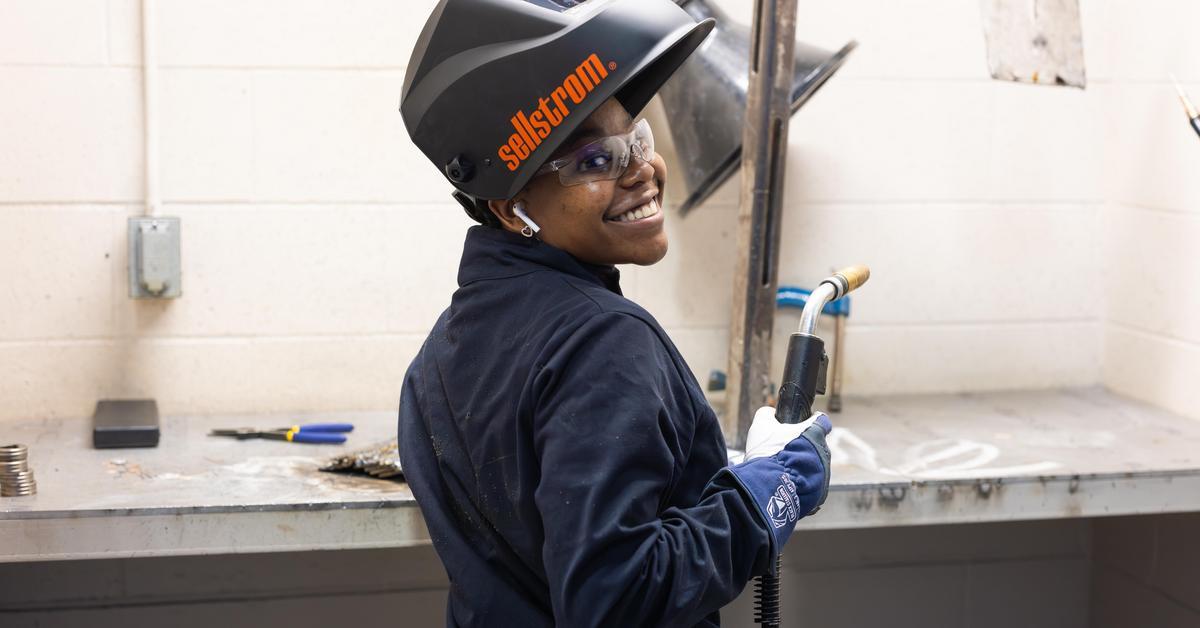
Tenpas: All right, we are going to pause here, but there is more to learn about the welding and metal fabrication program at Fox Valley Tech. So, stick with us, and if you have a question, feel free to text it on 920-281-1150. We will return with more right after this. Welcome back to Focus Fox Valley, our focus on careers. Joining us today, we are learning more about the welding and metal fabrication program. If you head to FVTC and search for “welding and metal fabrication,” a very cool image greets you, like I said, lots of sparks and important gear as well. Am I mistaken that helmets are a fun opportunity for students to get a little creative and express themselves, Craig?
Schmidt: Absolutely. Most of our students have some stickers or something written on their helmets to identify theirs.
Tenpas: That’s Craig Schmidt, department chair for welding and metal fabrication. We talked about job placement; it is excellent for our students. I am curious about what challenges or changes you have seen in the workplace. When someone is looking to get into this specific skill set, have you seen growth? What changes have you seen over your time?
Schmidt: The biggest thing we have seen is technological advancements. Going from manual welding to more robotics, AI is becoming part of some of our equipment now. So, there are a lot more robotics and automation. It’s not just welding that you have to understand the technological side now.
Tenpas: Yes, but you probably can’t replace that hand-to-hand, hand to metal.
Schmidt: That is very hard to replace. Absolutely. The basic knowledge of welding and understanding is still important and always will be. But like most companies, we have to make things faster.
Tenpas: It is almost an art form, though. I would argue that you can create some really beautiful things with this skill set.
Schmidt: Yes, a lot of people do the art stuff too. So, whether you are doing it as a job or doing it as a hobby. absolutely.
Tenpas: Credentials in this area, too; you can often further your education. Do you offer programs for students looking to level up in their field?
Schmidt: Yep. We offer an associate degree in industrial welding technology. It is all embedded, so everything from the diplomas applies directly to the associate degree. About 25% of our students go on for that degree.
Tenpas: Okay. Who would you say would be a good fit for this program?
Schmidt: Anyone who likes to be hands-on, you know; we get students that are all over the board and some students that maybe have never done this in their life but find a liking for it.
Tenpas: I know there has been a great push for women in this industry, too. What have you seen from that interest?
Schmidt: Our female population is growing. Every year, we get more and more, and they are really good at what they do.
Tenpas: I love that.
Schmidt: It is fun to see.
Tenpas: Absolutely. If anyone listening is thinking, “I’m curious about this program,” or maybe they have a child or grandchild who might be, what would you say to them?
Schmidt: I definitely head over to our website and find, like I said, welding on our website. Otherwise, reach out and give us a call, and we would be happy to give you a tour and help you learn more about the program.
Tenpas: Excellent. Craig, thank you so much for being here today.
Schmidt: Thank you for having me.
Tenpas: All right, folks, just search for manufacturing, welding, and metal fabrication.